nvidia-generative-ai-notes
Self Attention
The Core Mechanism: Self-Attention (Scaled Dot-Product Attention)
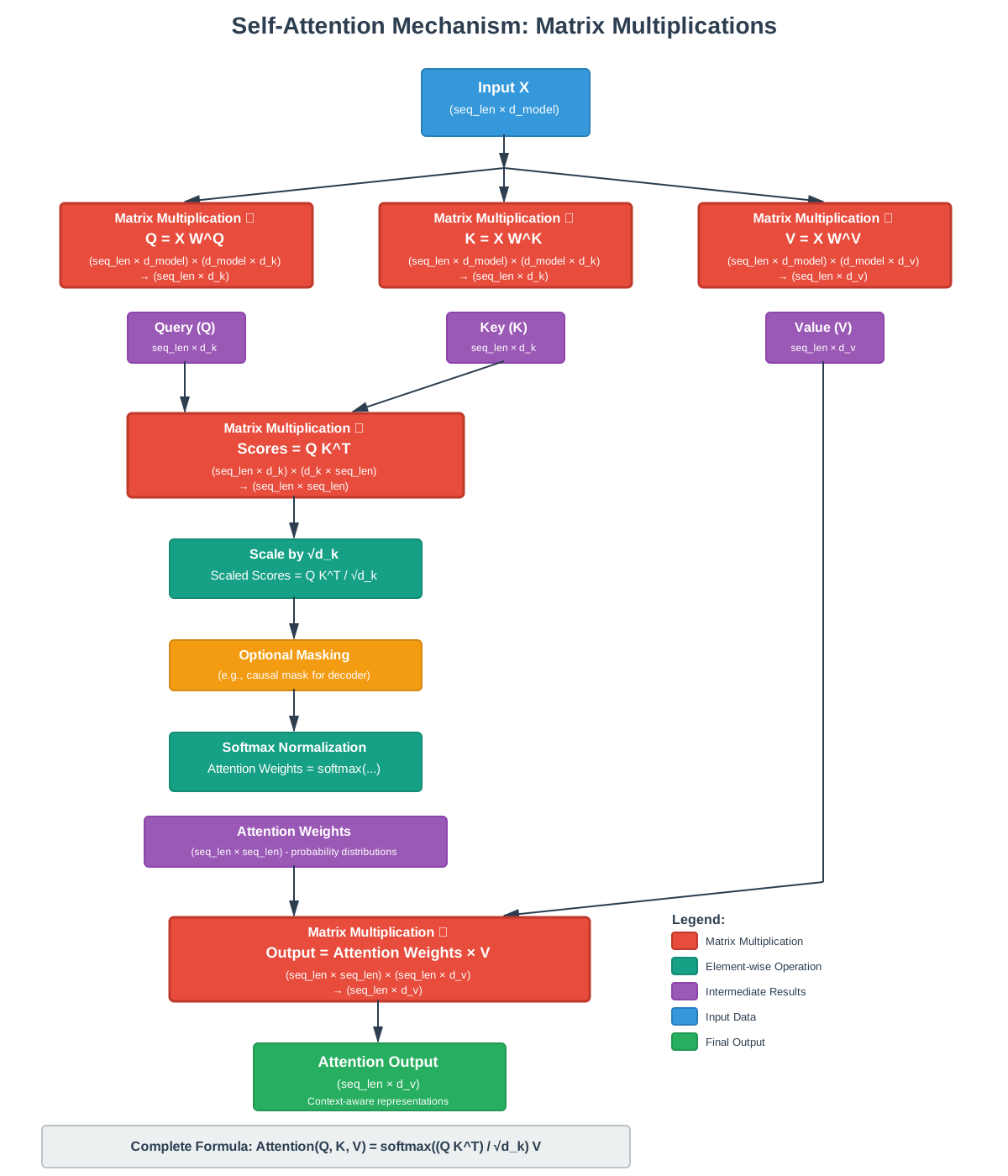
Self-attention is the heart of the Transformer. It allows every token in a sequence to attend to every other token (including itself), capturing contextual relationships in parallel.
For an input sequence of tokens represented as matrix X (shape: sequence_length × d_model), self-attention works as follows:
-
Project the input into three matrices using learned linear transformations:
Query matrix: Q = X W^Q
Key matrix: K = X W^K
Value matrix: V = X W^V
(W^Q, W^K ∈ ℝ^{d_model × d_k}, W^V ∈ ℝ^{d_model × d_v}; usually d_k = d_v = d_model / h) -
Compute raw attention scores via dot product:
Scores = Q K^T (shape: seq_len × seq_len) -
Scale by √d_k to stabilize gradients (prevents vanishing/exploding when d_k is large):
Scaled Scores = Q K^T / √d_k -
Apply optional masking (e.g., in decoder to prevent future peeking).
-
Normalize with softmax to get attention weights (probabilities):
Attention Weights = softmax(Scaled Scores) -
Weighted sum of values:
Attention(Q, K, V) = Attention Weights × V
This produces a new representation for each token that is a context-weighted combination of all tokens’ values.
Here is the mathematical formulation:
Attention(Q, K, V) = softmax( (Q K^T) / √d_k ) V
Multi-head Attention
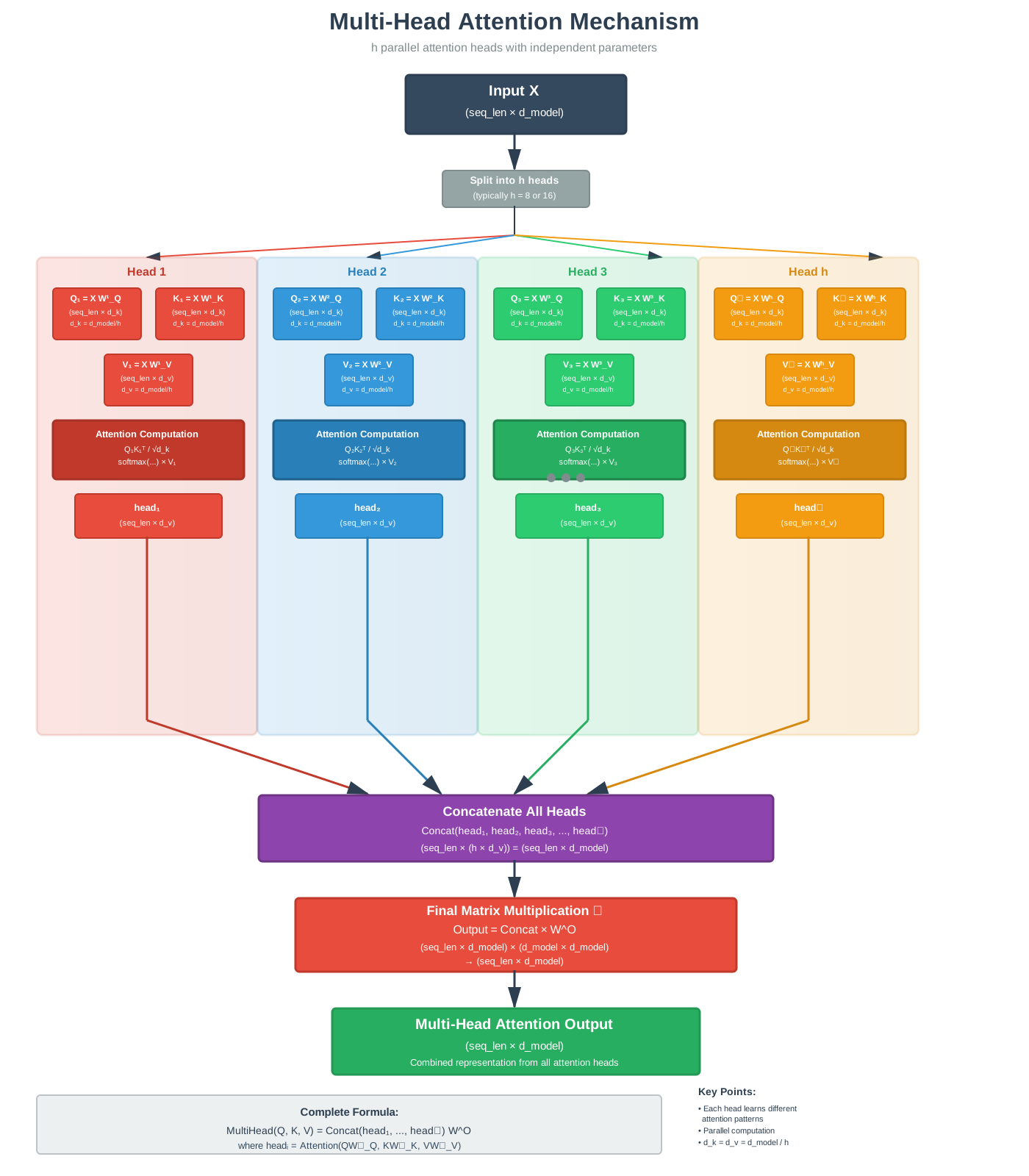
Instead of performing attention once with d_model-dimensional vectors, the Transformer splits the attention into h parallel “heads” (typically h=8 or 16). Each head operates in a lower-dimensional subspace (d_k = d_v = d_model / h).
- Each head has its own independent W^Q_i, W^K_i, W^V_i matrices.
- Compute attention independently in each head.
- Concatenate the h outputs → project back to d_model with a final linear layer.
Multi-Head Attention(Q, K, V) = Concat(head_1, …, head_h) W^O
Where head_i = Attention(Q W^Q_i, K W^K_i, V W^V_i)
Benefits:
Allows the model to jointly attend to information from different representation subspaces (syntax, semantics, coreference, etc.). Improves expressivity and generalization.
Why Transformers Excel
- Parallelization — No sequential dependencies like RNNs → much faster training.
- Long-range dependencies — Attention directly connects distant tokens (no vanishing gradients over distance).
- Dynamic weighting — Context-dependent importance learned end-to-end.